
Barn Owl Cams
| Florida Barn Owls Jan-May and Sept-Dec | Dorset Barn Owls February-June |
| More Live Wildlife Cams |
SPO Signup
GET UPDATES, DISCOVER NEW CAMS, IT’S FREE!
About
The ghostly, pale shape of the Barn Owl, most often seen as it hunts silently over fields at dusk, has excited much fear and suspicion among country-dwellers in the past, especially when the bird has uttered its typical rasping shriek– a sound to make the blood run cold in the semi-darkness. But in truth this bird poses no threat to humankind. Instead it is a ruthless and efficient hunter of small mammals, such as rats, mice, and shrews, often doing a farmer a considerable service by nesting in an outbuilding or barn and keeping mammal numbers down.
Interesting Fact:
Barn Owls have the keenest sense of hearing of any bird in the world.
Latest Posts:
- Barn Owl Rescued 70 Miles Offshore After Owl Fights Its Way AboardA barn owl rescue took an extraordinary turn 70 miles offshore when an exhausted owl kept fighting for a British Army racing yacht after three plunges into the sea.
- Female Barn Owl Tears Into Cached Rat Inside Florida Nest BoxA female barn owl returns to a cached rat and tears into the meal inside a South Florida nest box as nesting season approaches.
- Hatch Watch Begins at Oceanside Barn Owl Nest as Mel and Sydney’s First Chick ArrivesExcitement is building at the Oceanside Barn Owl Cam in California, where hatch watch has officially begun. After weeks of careful incubation, Mel and Sydney’s first chick has hatched, marking the start of what could soon become a lively brood inside the cozy owl box. The devoted barn owl pair currently has five eggs, and…
- Florida Barn Owl Cam Update: What Happened in the Two Nest BoxesWelcome to the Florida barn owl cam, where you can watch live barn owls nesting in Florida in real time. Over the past month, viewers of the live barn owl cams have witnessed a powerful, emotional, and very real chapter of barn owl life unfold across two neighboring nest boxes in South Florida. Based on…
- Barn Owl Cam (UF): 4th Egg Laid — Plus a Rare “Kiss” Between Mates (Nov 10, 2025)Quick recap Watch Live <— both cam1 and cam2 What the behavior means Dont’ forget to sign up for nest cam updates if you haven’t already done so! 🦉 What to watch next
- Barn Owl Cam (UF): 3rd Egg Laid Amid Food Shortage — Will She Stay or Abandon? (Nov 9, 2025)Watch the moment 🎥 Video: What happened (quick recap) This is a rare, raw look at how raptors balance parental investment against energetic stress when conditions turn tough. Watch Live <—- main streaming page Why the food gap matters (science snapshot) (Reminder: This stream is for observation only; no staging, no interference.) Timeline (Cam 1,…
- UF Barn Owl Cams: Egg #2 (Cam 1 Nest) & Egg #3 (Cam 2 Nest) — Live Lays, Timeline & What’s NextEgg #2 (Cam 1 Nest) Egg #3 (Cam 2 Nest) Quick recap (two nests, two cams) Watch Live Nest timelines (separate trackers) Cam 2 — (Egg #3 just laid) Cam 1 — (Egg #2 just laid) Why these events matter What’s next (for both nests) FAQs Are these the same owls?No. Cam 1 and Cam…
- Live Barn Owl Florida Cam1: First Egg Laid—Breeding Season Begins (UF | Charter Group Birdcams)Quick facts Watch Live What you’ll see in the video The cam captures the female settling into the nest box and laying Egg #1, the cue for incubation to begin. Expect short posture shifts, gentle repositioning of the egg, and attentive box checks. This is the official kickoff to the season. Why this is a…
- Congrats! Second Egg Laid LIVE at the Florida Cam2 Barn Owl Nest 🥚🦉Barn owl history—caught live! A female barn owl at the University of Florida has just laid her second egg on camera, giving us a front-row seat to one of nature’s most delicate moments. Watch the instant it happens and learn what comes next in the nesting cycle, from incubation to hatching. Watch Live Why this…
- Video – 1st egg laid – Florida Barn Owl Cam 2(10/31/25)Watch Live Florida Barn Owl Cam 2 delivered a Halloween surprise: the first egg arrived on October 31, 2025. More eggs will be coming over the next week or so. Incubation starts after the 1st egg is laid. Hatch is usually about 29-34 days after the egg is laid. Species Notes — Barn Owl (Tyto…
How they pick a mate:
Recent research has shown that males prefer to breed with females with plenty of spots on their thighs, a unique feature that seems to reflect a birds health.
Where Barn Owls nest:
Barn Owls are not just in barns, but also can be found in churches and other buildings, including natural sites such as caves and tree-holes.
I see the owlets, but where are the parents?
During the first couple weeks after the owlets hatch the female will remain in the box during the day with the owlets. The male will stay close bye perched in a nearby tree during daylight hours. Once the owlets reach a certain size(usually a couple weeks from when they hatch) the female will leave the box and perch in a nearby tree during the day along with the male. At night the male and female both take turns feeding the owlets and then return to their perch by morning.
How long before eggs hatch:
The owlets hatch out after about 30 days. The female begins incubation immediately after the 1st egg is laid. This means every egg will hatch on a different day. It will be another 3 months or more before they are independent after they hatch.
What is a pip?
A pip hole is a tiny hole that the eaglet inside the egg makes with its “egg tooth” (a sharp little point at the end of its beek) in the outside shell when it first starts to hatch.
Adult Female Barn Owl
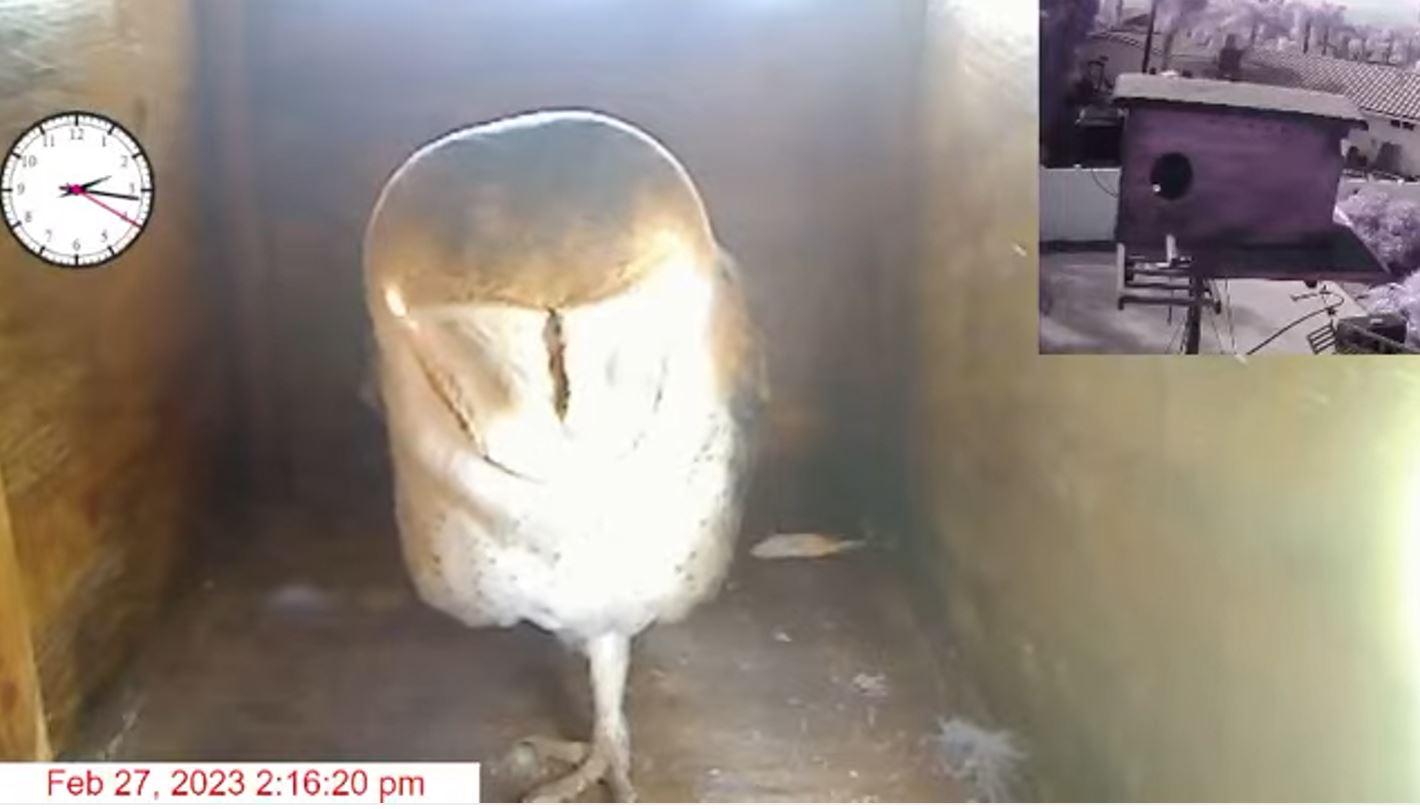
About the Nest:
There is no real “nest”, the female just lays the 4-7 eggs right on the floor, usually among old owl pellets.
Characteristics and Habitat
Size: 13-17 inches (33-35 cm)
Weight: 10-21oz (275-600g)
Migration: Nonmigrant
Habitat: Farmland, Marshes, Prairie and Desert
Population: Fairly Common Resident, Although Numbers Have Decreased In Recent Years.
The light at night:
Yes, they do have a light shining on them all night long. However, the light is called infrared and can’t be seen by humans or animals. Only cameras can pick it up. If you walked out to that nest at night it would look pitch black outside.
The Barn Owl looks unlike other owls, it has a peculiar heart-shaped face and small, black eyes. The arrangement reflects how it uses its senses. The eyes are of secondary importance in hunting prey; it is the ears that are used primarily. Its round face helps to amplify sounds, while the silent flight, typical of all owls, keeps background noise to a minimum. The ears are not symmetrical on the head, the left side is higher on the skull than the right. This means that sound traveling from below or above will arrive at one ear before the other, and this delay helps the owl to distinguish which direction the sound is coming from. The Barn Owl has three-dimensional hearing. It can catch food in complete and total darkness.